Temperature-responsive shape recovery
TC-85 specimens showed recovery toward their original form at 37°C under the reported test conditions.
Read the study ↗
SmartAligners are direct-printed from the approved digital plan. That gives the clinical team a clearer route to variable thickness, designed pressure regions and a shape-memory material evaluated at oral temperature.
An intraoral scan captures the arch before any plan is proposed. It replaces a physical impression, not the clinician's examination or diagnosis, and the digital file becomes the single reference the whole case is planned and printed from.
See the clinical planning step →Graphy's clinical guide frames the technology around three manufacturing limits: one uniform sheet thickness, a fixed rectangular pressure area and a physical model between the digital plan and the appliance. These are design and material differences in how the appliance is made.5
Traditional clear-aligner production commonly thermoforms a plastic sheet over a model. Direct printing removes that model-forming step. Published laboratory work reports that thermoforming can alter material thickness and geometry; direct printing creates a different production route, but its result still depends on validated print and post-processing controls.2
Open the clinician production workflow →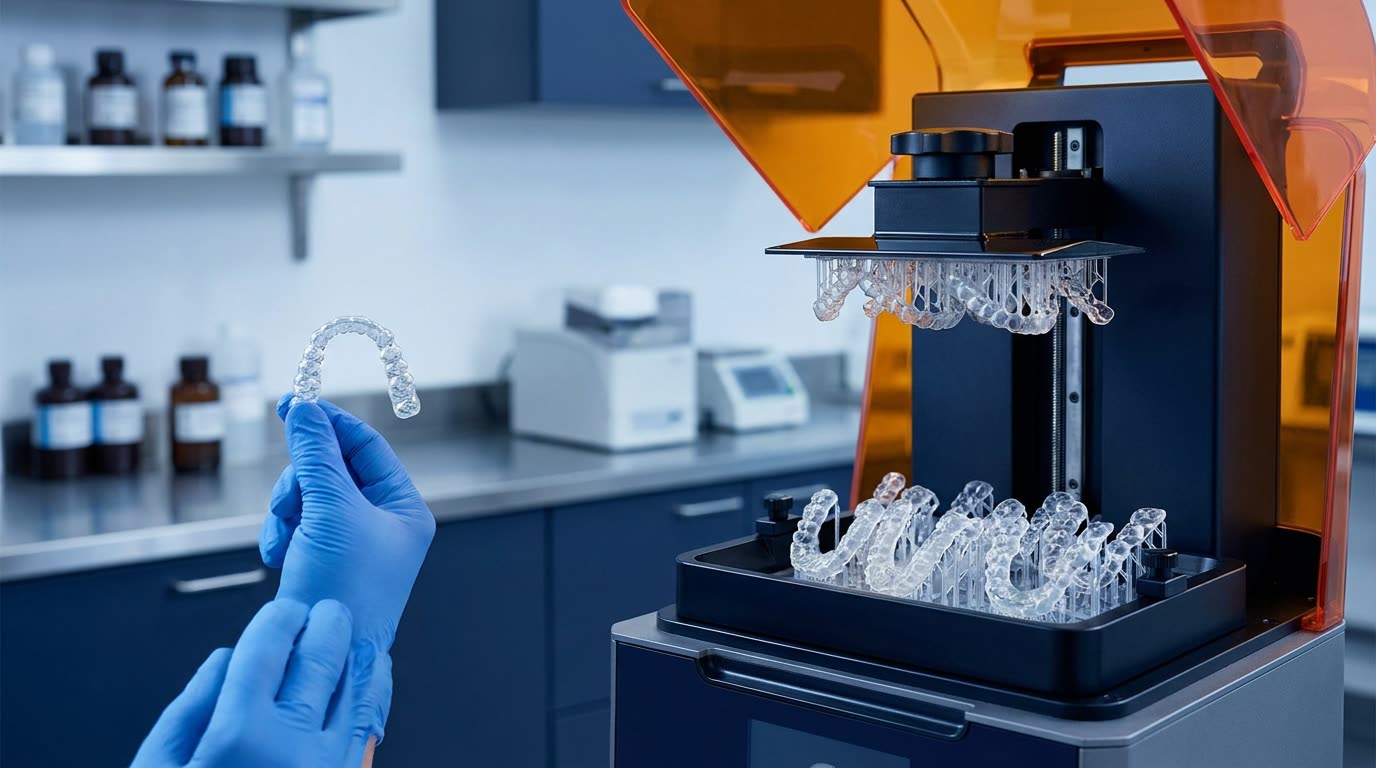
In a 2022 laboratory study, TC-85 specimens recovered toward their original form at 37°C after controlled deformation. The authors also reported different viscoelastic and thickness behavior from the PETG control.2
The study was a material test, not a randomized patient trial. Clinical movement still depends on diagnosis, staging, biology, wear and review.
| Elapsed time | |||||||
|---|---|---|---|---|---|---|---|
| Elapsed time | 0 | 10 sec | 30 sec | 1 min | 5 min | 10 min | 60 min |
| Bending angle (°) | 177.00 ± 1.44 | 146.27 ± 3.92 | 107.23 ± 7.05 | 79.43 ± 6.45 | 31.53 ± 5.48 | 20.32 ± 5.49 | 6.90 ± 2.68 |
| Shape recovery ratio (%) | 0 | 17.36 ± 2.06 | 39.42 ± 3.90 | 55.12 ± 3.64 | 82.19 ± 3.09 | 88.52 ± 3.10 | 96.11 ± 1.50 |
The label beneath each point matters as much as the claim itself.
TC-85 specimens showed recovery toward their original form at 37°C under the reported test conditions.
Read the study ↗A sensor-based study found that selectively changing direct-printed aligner thickness altered measured forces and moments.
Read the study ↗A 2023 review described direct-printable orthodontic materials as an active area of research and called for stronger standardized and clinical evidence.
Read the review ↗Graphy reports 99.6% dimensional accuracy for direct printing in its own product data.
Graphy's clinical guide summarises Schupp et al. (Journal of Aligner Orthodontics, 2023) as recovering about 70-80% of force in the first 6-8 days and continuing through day 14.
| Elapsed | Residual angle | Recovery |
|---|---|---|
| 0 s | 177.00° ± 1.44 | 0% |
| 10 s | 146.27° ± 3.92 | 17.4% |
| 30 s | 107.23° ± 7.05 | 39.4% |
| 1 min | 79.43° ± 6.45 | 55.1% |
| 5 min | 31.53° ± 5.48 | 82.2% |
| 10 min | 20.32° ± 5.49 | 88.5% |
| 60 min | 6.90° ± 2.68 | 96.1% |
Strain at yield in a static tensile test at 25 °C (Lee et al. 2022). PETG reached the higher yield stress: 44.20 MPa against 32.31 MPa for TC-85.
| Material | Elastic limit |
|---|---|
| TC-85 resin (Graphy) | 4.65% |
| Conventional PETG | 3.92% |
Graphy. Shape Memory Aligner Workflow. Accessed July 2026.
graphysma.com/sma-workflow ↗Lee SY, Kim H, Kim HJ, et al. Thermo-mechanical properties of 3D printed photocurable shape memory resin for clear aligners. Scientific Reports. 2022;12:6246.
doi:10.1038/s41598-022-09831-4 ↗Grant J, Foley P, Bankhead B, et al. Forces and moments generated by 3D direct printed clear aligners of varying labial and lingual thicknesses during lingual movement of maxillary central incisor: an in vitro study. Progress in Orthodontics. 2023;24:23.
PubMed 37423974 ↗Goracci C, Juloski J, D'Amico C, et al. Clinically Relevant Properties of 3D Printable Materials for Intraoral Use in Orthodontics: A Critical Review of the Literature. Materials. 2023;16(6):2166.
PubMed 36984045 ↗Bae BG, et al. A study on the compressive strength of three-dimensional direct printing aligner material for specific designing of clear aligners. Scientific Reports. 2025;15:2489.
doi:10.1038/s41598-025-86687-4 ↗Choi JY, Kim H, Kim SH, et al. Mechanical and viscoelastic properties of a temperature-responsive photocurable resin for 3D printed orthodontic clear aligners. Scientific Reports. 2025;15:23530.
doi:10.1038/s41598-025-93026-0 ↗Koenig N, Choi JY, McCray J, et al. Comparison of dimensional accuracy between direct-printed and thermoformed aligners. Korean Journal of Orthodontics. 2022;52(4):249-257.
doi:10.4041/kjod21.269 ↗Oyonarte R, et al. Mechanical properties of thermoformed and direct-printed aligner materials after immersion in 37 °C water: a 14-day in vitro study. Scientific Reports. 2026;16:5864.
doi:10.1038/s41598-026-36723-8 ↗A clinician can tell you whether clear aligners are suitable and what the realistic plan looks like.
Find a Provider